
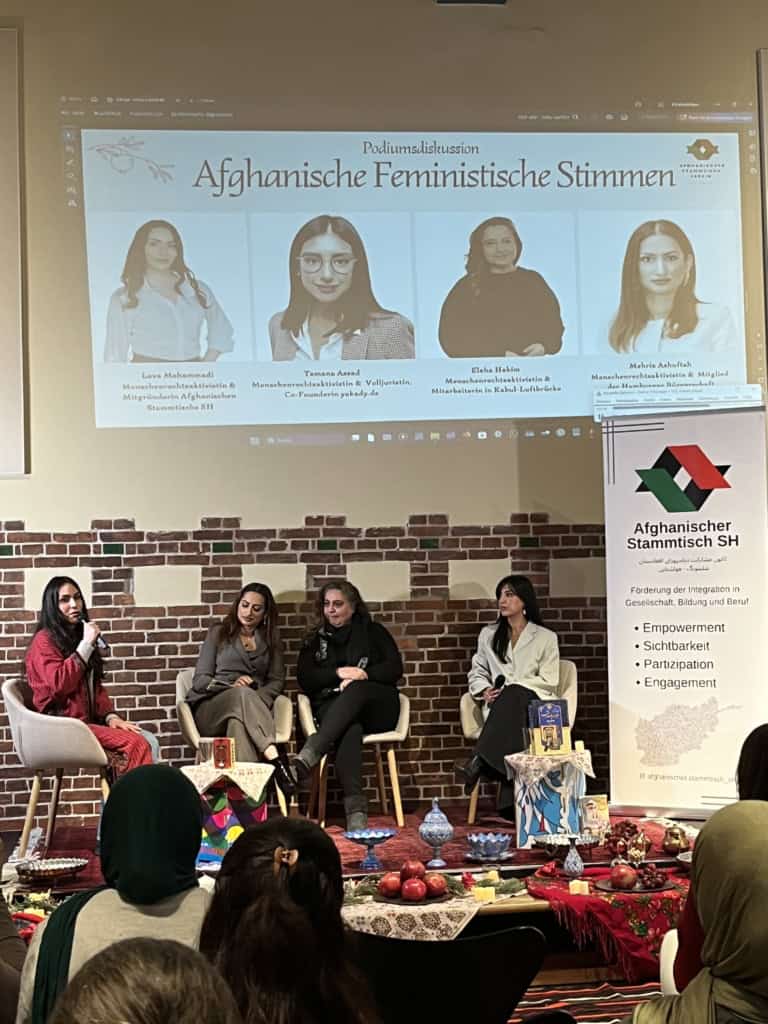

Shab-e-Yalda is celebrated in Afghanistan as the longest night of the year—a night of community, hope, and poetry. It is a night when people come together to talk, listen, remember, and support one another, trusting that light will return after darkness.
This meaning touches on the core of #hundertausendmuetter: making visible the care, responsibility, and life that is carried out under the most adverse conditions—often by mothers, frequently in secret, and almost always under structural uncertainty.
The Afghan Stammtisch Schleswig-Holstein used Shab-e-Yalda to celebrate its fourth anniversary under the motto „Afghan feminist voices“ to invite social dialogue. An evening that impressively demonstrated how closely motherhood, flight, political violence, and survival strategies are intertwined.
In the discussions between Hadia Armaghan, Hila Latifi, Farangis Sawgand, and Trina Mansoor Literature and poetry in exile became a tangible space for survival: a place where experiences of loss, flight, and uprooting could be captured in language. Literature as an act of self-assertion—and as a bridge between generations and worlds.
The voices of Lava Mohammadi, Mehria Ashuftah, Eleha Hakim, and Tamana Assad made clear what it means to be a woman under conditions of constant threat. Reports from Kabul and Pakistan told of traumatized children, of mothers who bear responsibility even though they have been deprived of all security, and of fathers who must endure the experience of being unable to protect their families.
These experiences point to a structural dimension of maternal health: to powerlessness, to political decisions that endanger lives, and to the long-term psychological consequences for families. They raise the pressing question of how it can be that Germany denounces human rights violations—and at the same time effectively legitimizes a Taliban regime. That people who have worked for or with German institutions have been abandoned. A political shame that is not abstract, but is concretely inscribed in the bodies, biographies, and future prospects of mothers and children.
For us, it is clear: Mothers are not a marginal issue in international politics. Their experiences are a seismograph for social violence, for the failure of protection systems, and for the urgency of feminist, human rights-based politics.
At the same time, it became clear that evening what really matters: Cohesion in the diaspora, Solidarity, feminist networks, intergenerational and transnational communication. Spaces where mothers appear not only as affected parties, but as political actors, as narrators, as shapers of the future.
Shab-e-Yalda reminds us why we are running this campaign:
The night can be long. For many mothers, it already has been for a long time.
But in sharing stories, in making things visible, and in acting in solidarity and politically, there lies hope for the light to come.